Work Injury Doctor in Pasadena, TX
Injured on the job at a refinery, warehouse, construction site, or industrial facility in Pasadena? See a doctor today and pay nothing out of pocket. We treat work-related injuries on a Letter of Protection - which means you get immediate medical care while your workers' compensation claim is processed or your third-party injury lawsuit is pursued. Pasadena's industrial corridor along Highway 225 and the Houston Ship Channel creates high-risk work environments. Refinery explosions, chemical exposures, falls from heights, equipment malfunctions, and repetitive strain injuries disable workers daily. Don't let your employer or their insurance company deny the medical care you need. Our doctors specialize in documenting occupational injuries that maximize both workers' comp benefits and third-party liability claims worth $100,000 to $1 million+.

Work Injuries We Treat in Pasadena
Pasadena is one of the most dangerous places to work in America. The concentration of petrochemical refineries, chemical plants, manufacturing facilities, and maritime operations creates constant occupational hazards. Workers suffer catastrophic injuries from explosions, toxic exposures, heavy machinery accidents, and repetitive trauma.
Our work injury doctors in Pasadena treat injuries across all industrial sectors: refinery workers, longshoremen, construction crews, warehouse employees, truck drivers, and office workers with repetitive strain injuries.

We understand that work injuries involve complex legal issues beyond standard medical treatment: Workers' compensation claims (limited benefits, no pain and suffering), third-party liability claims (full damages against equipment manufacturers, contractors, property owners), maritime injuries (Jones Act, Longshore Act - different laws than workers' comp), and OSHA violations (federal safety regulation breaches). Every injury must be documented to protect your right to maximum compensation from all available sources.
Refinery and Chemical Plant Injuries
Explosions, fires, chemical burns, toxic inhalation injuries, heat exhaustion, radiation exposure, crush injuries from equipment failures. Pasadena refineries (Shell, ExxonMobil, Valero, Chevron Phillips) employ thousands but expose workers to catastrophic risks. Injuries often involve multiple body systems requiring specialists, months of treatment, permanent disabilities.
Falls from Heights
Construction workers, scaffold builders, maintenance crews fall from ladders, roofs, platforms, scaffolding. Heights above 6 feet can cause fatal injuries. Survivors suffer spinal fractures, traumatic brain injuries, pelvic fractures, multiple broken bones. Texas leads nation in construction worker deaths - most from falls.
Crushing Injuries and Amputations
Heavy machinery accidents, forklifts, conveyor belts, industrial presses crush hands, arms, legs. Traumatic amputations occur at scene or surgical amputations required later. Victims face permanent disability, prosthetic needs, vocational retraining. High-value claims due to lifetime impairment.
Back Injuries and Herniated Discs
Lifting injuries, repetitive bending/twisting, vibration exposure from equipment. Longshoremen, warehouse workers, delivery drivers suffer lumbar disc herniations, spinal stenosis, chronic pain. May require surgery, epidural injections, permanent work restrictions. Most common workers' comp claim.
Repetitive Strain Injuries
Carpal tunnel syndrome, rotator cuff tears, tendonitis, bursitis from repetitive motions. Assembly line workers, warehouse pickers, computer users develop cumulative trauma over months/years. Often denied by employers claiming "not work-related." Requires detailed medical documentation proving occupational causation.
Chemical Burns and Toxic Exposures
Skin contact with acids, bases, solvents. Inhalation of toxic fumes. Eye injuries from chemical splashes. Pasadena refineries handle benzene, hydrogen sulfide, sulfuric acid, caustic chemicals. Acute exposures cause immediate burns. Chronic exposures cause cancer, neurological damage, respiratory diseases. Long-term claims worth millions.
Hearing Loss
Noise-induced hearing loss from industrial equipment, construction sites, refineries. OSHA requires hearing protection above 85 decibels but enforcement is weak. Permanent hearing damage reduces earning capacity, requires hearing aids, affects quality of life. Undervalued by workers' comp but significant in third-party claims.
Eye Injuries
Foreign objects, chemical splashes, arc welding flash burns, flying debris. Can cause blindness, vision loss, need for corrective surgery. Welders, machinists, construction workers at highest risk. Permanent vision impairment drastically reduces employability.
Electrocution Injuries
Contact with live electrical wires, equipment malfunctions, inadequate lockout/tagout procedures. Causes cardiac arrest, severe burns, nerve damage, muscle destruction. High fatality rate. Survivors face months of burn treatment, skin grafts, physical therapy.
Heat-Related Illnesses
Heat exhaustion, heat stroke from working outdoors in Texas summer heat or inside refineries near furnaces. Construction workers, refinery operators, dock workers at highest risk. Can cause organ failure, brain damage, death if not treated immediately.
Why Immediate Medical Attention Matters for Work Injuries
Employers and workers' comp insurance carriers use treatment delays to deny claims. "If injury was work-related, employee would have reported immediately and sought treatment." Any delay gives them ammunition.
Also, many occupational injuries worsen without treatment: Chemical exposures cause progressive tissue damage, spinal injuries risk permanent nerve damage, infections from puncture wounds can become life-threatening, concussions require immediate evaluation to prevent second-impact syndrome.
See a doctor within 24 hours of workplace injury. Report injury to employer in writing. Get medical documentation proving causation.
What to Do After a Work Injury in Pasadena, TX
The first 24-48 hours after workplace injury determine whether you receive proper medical care and fair compensation. Employers and insurance carriers activate strategies to minimize liability and deny claims.
Report Injury to Employer Immediately
Texas law requires you to report within 30 days or lose workers' comp benefits. Report sooner - ideally same day or next day. Report in writing (email, text, written note). Keep copy. Verbal reports get "forgotten" by employers. Include: Date, time, location of injury. What happened. Body parts injured. Witnesses present.
Seek Medical Treatment Immediately
For emergency injuries: Go to ER. Employer cannot prevent you from getting emergency care. For non-emergency injuries: See workers' comp doctor if employer has one designated. BUT if treatment is inadequate or doctor minimizes injuries, you have right to second opinion. If employer refuses to authorize treatment or delays: See us immediately on Letter of Protection. We treat while you fight for workers' comp approval.
Document Everything
Photos of injury location showing hazard. Photos of equipment involved. Photos of visible injuries. Witness contact information. Safety violation evidence (missing guards, no warning signs, inadequate training). Your work schedule (proves you were on-duty when injured). Employers "fix" hazards within hours to hide evidence. Photograph immediately.
File Workers' Compensation Claim
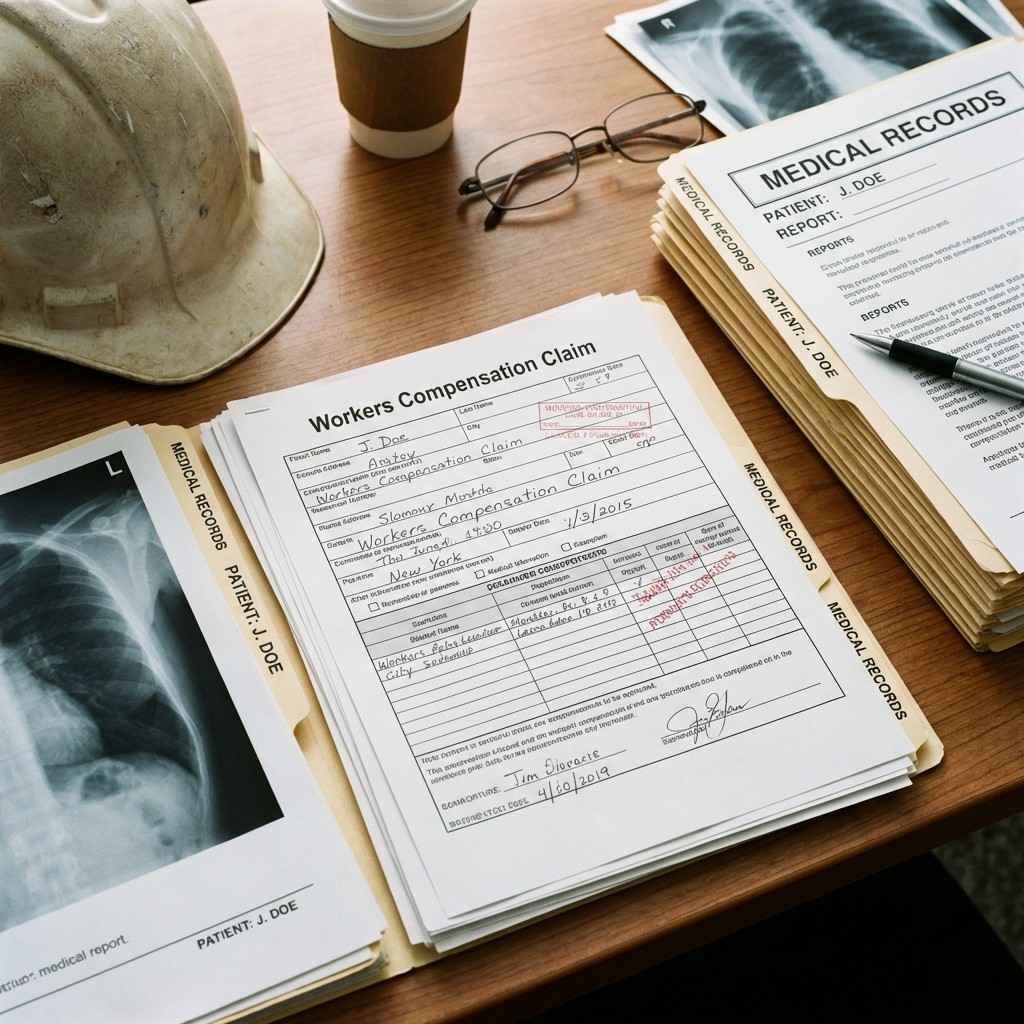
Complete DWC-041 (Employee's Claim for Compensation) form. Mail to insurance carrier. Keep copy. Deadline: 1 year from injury date (but report to employer within 30 days).
Contact Work Injury Attorney
Workers' comp provides limited benefits: Medical care (but only approved treatments), temporary income benefits (70% of wages, max $1,107/week in 2026), permanent impairment benefits (based on rating), NO pain and suffering, NO punitive damages. Third-party claims provide full damages: If injury caused by defective equipment → sue manufacturer. If injury caused by contractor's negligence → sue contractor. If injury on someone else's property → sue property owner. If employer lacks workers' comp insurance → sue employer directly. Attorney determines all liable parties and maximizes total compensation.
Common Mistakes That Destroy Work Injury Claims
Work Injury Treatment with No Insurance - Letter of Protection
Work injury victims face multiple financial barriers: Employer's workers' comp insurance denies claim, leaving you with no medical coverage. Workers' comp approves claim but only authorizes minimal treatment (refuses MRI, surgery, specialist referrals). You have third-party claim against equipment manufacturer but can't afford treatment while lawsuit pending (takes 1-2 years). Employer has no workers' comp insurance (illegal but common in small businesses, construction subcontractors).
Letter of Protection solves all these problems by allowing immediate access to comprehensive medical care while legal claims are pursued.
What is a Letter of Protection for Work Injury Cases?
A Letter of Protection (LOP) is a three-way agreement between you (the patient), your work injury attorney, and medical providers. Your attorney issues written guarantee that medical bills will be paid from settlement or judgment proceeds.
This means:
- You receive all medically necessary treatment immediately
- No upfront payment, no monthly bills, no collections
- Medical providers agree to wait for payment until case resolves
- Bills paid from settlement/judgment before you receive your portion
For work injury cases, LOP typically covers:
- Orthopedic surgery (spinal fusions, joint replacements, fracture repairs)
- Diagnostic imaging (MRI, CT scans, nerve conduction studies)
- Physical therapy (months of rehabilitation)
- Pain management (epidural injections, nerve blocks, medication)
- Specialist consultations (neurosurgery, occupational medicine, toxicology)
- Vocational rehabilitation (retraining for new career if can't return to prior job)
- Psychological counseling (PTSD from traumatic workplace accidents)
Total bills often reach $50,000-$300,000+ for severe occupational injuries.
Who Qualifies for Letter of Protection?
You qualify if:
You may NOT qualify if:
We evaluate every case individually.
How Letter of Protection Works with Workers' Compensation
Scenario 1: Workers' Comp Denied
You file workers' comp claim. Insurance denies claim saying injury "not work-related" or "pre-existing condition." You appeal denial (takes 6-12 months). Meanwhile, you need treatment NOW. LOP solution: Attorney issues LOP. You receive treatment. When you win appeal, workers' comp pays medical bills retroactively. LOP released. If you lose appeal but have third-party claim: Medical bills paid from third-party settlement.
Scenario 2: Workers' Comp Approved But Inadequate
Workers' comp authorizes 6 physical therapy sessions. Your doctor recommends 24 sessions plus MRI plus specialist consultation. Workers' comp refuses additional treatment. LOP solution: Continue treatment under LOP. Document medical necessity. Use comprehensive treatment records to prove workers' comp should have authorized more care. Sue workers' comp carrier for bad faith denial. Medical bills paid from bad faith settlement or third-party claim.
Scenario 3: Third-Party Claim (Equipment Defect, Contractor Negligence)
You're entitled to workers' comp benefits (limited) PLUS third-party lawsuit (unlimited damages). Workers' comp pays for initial treatment. But you need extensive ongoing care while third-party lawsuit pending (takes 1-2 years). LOP solution: Workers' comp pays initial bills. Additional treatment under LOP paid from third-party settlement. This preserves your settlement money rather than depleting it on medical bills upfront.
Scenario 4: Employer Has No Workers' Comp Insurance
Texas law requires most employers to carry workers' comp OR be approved "non-subscriber." But many small businesses and construction subcontractors illegally operate without coverage. If employer has no workers' comp: You can sue employer directly for full damages (pain and suffering, lost wages, medical bills). This is BETTER than workers' comp because damages are unlimited. LOP solution: Attorney sues employer. You receive treatment under LOP while lawsuit proceeds. Medical bills paid from judgment against employer.
Letter of Protection Success Rate for Work Injuries
Success rate depends on case type:
Workers' comp appeals
60-70% win rate
(many denials are illegitimate)
Third-party claims
90%+ settlement rate
(equipment manufacturers, contractors settle to avoid trial)
No workers' comp insurance claims
95%+ settlement rate
(employers have no defense)
Unrepresented worker settlement
$10,000-$30,000
(workers' comp only, no third-party claim pursued)
Represented worker with LOP treatment
$75,000-$500,000+
(workers' comp + third-party claim + comprehensive documentation)
The medical documentation we provide is the difference between minimal workers' comp benefits and life-changing settlements.
Common Work Injury Types in Pasadena, TX
Pasadena's economy centers on petrochemical refining, maritime operations, warehousing, and construction. Each industry creates specific injury patterns.
Our clinic is located on Woodlawn Ave, less than 3 miles from: Shell Deer Park Refinery (largest in U.S.), ExxonMobil Baytown Refinery, Valero Houston Refinery, Houston Ship Channel docks, Port of Houston container terminals, and hundreds of warehouses and distribution centers.
We've treated thousands of injured workers from every industrial sector in Harris County.
Our clinic is strategically located to serve workers across Pasadena's industrial corridor, providing immediate medical care and comprehensive documentation for both workers' compensation and third-party claims.

Refinery and Chemical Plant Injuries
What causes injuries: Explosions and fires (equipment failures, gas leaks, process upsets). Chemical exposures (skin contact, inhalation, eye splash). Falls from platforms, scaffolding, ladders. Heat stress (working near furnaces in summer heat). Struck-by injuries (falling objects, moving equipment). Confined space accidents (oxygen deficiency, toxic atmospheres).
Common locations: Shell Deer Park: 1,400+ workers, frequent chemical releases. ExxonMobil Baytown: 3,700+ workers, explosion history. Valero Houston: Processing units, maintenance turnarounds. Chevron Phillips Cedar Bayou: Ethylene production hazards.
Typical Injuries:
Key Legal Point
Multiple potentially liable parties: Employer (workers' comp only, limited benefits), equipment manufacturer (defective safety systems, valve failures), maintenance contractor (negligent repairs), safety equipment manufacturer (defective respirators, protective gear), chemical supplier (inadequate hazard warnings). Refinery injury cases often involve OSHA violations, Federal Clean Air Act violations, product liability claims, and premises liability.
Compensation Ranges
Moderate injuries (burns, fractures): $75,000-$250,000. Severe injuries (permanent disability, organ damage): $300,000-$1 million+. Catastrophic injuries (death, permanent total disability): $1-5 million+
Construction Site Injuries
What causes injuries: Falls from heights (roofs, scaffolds, ladders). Struck by falling objects (tools, materials dropped from above). Electrocution (contact with power lines, faulty equipment). Caught between equipment (trenches, heavy machinery). Scaffold collapses. Ladder failures.
Common locations: Refinery turnaround projects (scheduled maintenance requiring 1,000+ contract workers), new construction along Highway 225 corridor, warehouse construction near Port of Houston, residential developments in South Houston.
Typical Injuries:
Key Legal Point
General contractor, subcontractors, property owner, equipment rental companies all potentially liable. Example: Worker falls from scaffold. Employer (workers' comp), scaffold manufacturer (defective design), scaffold rental company (failed to inspect), general contractor (failed to enforce safety rules), property owner (unsafe work site). Each defendant has separate insurance. Total available coverage can reach $10 million+. OSHA regulations heavily favor injured workers. Any OSHA violation at time of injury proves negligence.
Compensation Ranges
Falls from heights with serious injuries: $200,000-$1 million. Electrocution survivors: $300,000-$2 million. Wrongful death: $1-5 million
Warehouse and Distribution Center Injuries
What causes injuries: Forklift accidents (struck by, run over, crushed). Repetitive lifting injuries (back, shoulders). Falls from loading docks. Slips and falls on warehouse floors. Falling merchandise (improperly stacked pallets). Conveyor belt accidents (caught in machinery).
Common locations: Amazon fulfillment centers, industrial distribution warehouses along Beltway 8, Port of Houston cargo facilities, cold storage facilities.
Typical Injuries:
Key Legal Point
Employers pressure workers to not report: Threaten termination, offer light duty to keep injury off OSHA logs, claim injury "wasn't work-related." Many warehouse workers are temp agency employees, immigrants, or undocumented workers who fear retaliation. Result: Injuries go untreated until chronic pain forces medical attention months/years later. We advise workers: Always report injuries immediately in writing. Texas law protects you from retaliation. Third-party liability common: Forklift manufacturer (defective brakes, visibility issues), pallet rack manufacturer (collapse due to design defect), temp agency (inadequate training), property owner (unsafe premises if employer is tenant).
Compensation Ranges
Repetitive strain injuries: $30,000-$150,000. Forklift accidents with serious injuries: $100,000-$500,000. Permanent disability cases: $200,000-$1 million+
Maritime and Longshore Injuries
What causes injuries: Slip and falls on ship decks, docks. Cargo handling accidents (containers, cranes). Vessel collisions. Crane accidents. Toxic exposures (asbestos, chemicals). Repetitive strain from cargo operations.
Common locations: Houston Ship Channel docks, Port of Houston container terminals, barge operations, ship repair facilities, offshore oil/gas support vessels.
Typical Injuries:
Key Legal Point
Jones Act (for seamen): Covers crew members on vessels. Allows lawsuit against vessel owner for negligence. Allows "unseaworthiness" claims (vessel/equipment defects). Provides maintenance and cure benefits. MUCH more favorable than workers' comp. Longshore and Harbor Workers' Compensation Act: Covers dock workers, longshoremen, ship repair workers. Federal workers' comp (better benefits than state workers' comp). Allows third-party claims against vessel owners, equipment manufacturers. Key difference from regular workers' comp: Maritime workers can sue for pain and suffering, lost wages, full damages.
Compensation Ranges
Jones Act claims: $200,000-$2 million (juries are very pro-seaman). Longshore Act + third-party claims: $150,000-$1 million. Death claims: $1-5 million
Delivery Driver and Transportation Injuries
What causes injuries: Vehicle accidents (commercial truck crashes). Loading/unloading injuries (lifting, falls from truck beds). Repetitive strain (getting in/out of truck hundreds of times daily). Slips and falls during deliveries. Assaults (delivery drivers robbed, attacked).
Common locations: Amazon delivery contractors, FedEx, UPS drivers, freight companies, food delivery services.
Typical Injuries:
Key Legal Point
Vehicle accidents = sue at-fault driver + their insurance. Workers' comp pays medical bills. Third-party claim pays full damages. Example: Amazon driver rear-ended by drunk driver. Workers' comp pays $20,000 medical bills. Third-party lawsuit against drunk driver pays $300,000 (pain and suffering, lost wages, future medical). Total recovery: $320,000.
Compensation Ranges
Minor injuries: $20,000-$75,000 (workers' comp only). Vehicle accidents with third-party liability: $100,000-$500,000. Permanent disability: $200,000-$1 million+
Office and Clerical Worker Injuries
What causes injuries: Repetitive strain (carpal tunnel, tendonitis from computer use). Slip and falls in office. Ergonomic injuries (poor workstation setup). Stress-related conditions.
Common locations: Office environments across all industries.
Typical Injuries:
Key Legal Point
Employers claim "not work-related" because injury developed gradually, not sudden traumatic event. Texas workers' comp law covers "repetitive trauma" injuries. But requires proof: Work duties caused or significantly contributed to condition. No other explanation exists (not caused by hobbies, home activities). We document: Detailed job duty analysis (hours per day typing, mouse use, phone use), ergonomic assessment of workstation, clinical findings (positive Phalen's test, Tinel's sign for carpal tunnel), nerve conduction studies proving nerve damage, causation analysis eliminating non-work factors.
Compensation Ranges
Carpal tunnel surgery: $15,000-$50,000. Multiple repetitive strain injuries: $30,000-$100,000. Permanent restrictions affecting employment: $50,000-$150,000
What to Expect at Your First Work Injury Doctor Appointment
Work injury evaluations require detailed occupational history, injury mechanism analysis, and documentation that satisfies both workers' comp requirements and potential third-party liability claims. Your first visit typically takes 60-90 minutes.
Occupational History and Injury Details (20 minutes)
You'll complete detailed paperwork covering: Employment information (employer name, job title, supervisor name, hire date, work schedule), injury details (exact date and time, what you were doing when injured, how injury occurred, body parts injured), witnesses present, whether injury was reported to employer (when, to whom, in writing or verbal), workers' comp claim status (filed, approved, denied, pending), previous injuries or pre-existing conditions, current work status (still working, light duty, off work entirely). Our doctor will conduct detailed occupational interview: Describe your typical workday and specific job duties. What movements/activities does your job require? What equipment/tools do you use? Safety training received? Safety equipment provided? How did injury occur (step-by-step)? Did you notice hazard before injury? Have you seen other workers injured same way? Did employer provide proper equipment/training? Any OSHA violations you're aware of?
This establishes work-relatedness and identifies potential third-party liability.
Physical Examination (25 minutes)
Comprehensive evaluation including: Inspection of injured area (swelling, bruising, deformity, scars), palpation (identifying pain, muscle spasm, tenderness), range of motion testing (measured in degrees, compared to uninjured side), strength testing (graded 0-5 scale), neurological examination (reflexes, sensation, nerve function), functional testing (can you perform job duties? what limitations?), gait analysis if lower extremity injury, ergonomic assessment if repetitive strain injury.
Everything documented. Workers' comp and third-party claims require objective findings, not just subjective complaints.
Diagnostic Imaging Coordination (10 minutes)
Based on examination, we order: X-rays (fractures, dislocations, arthritis), MRI (soft tissue injuries, herniated discs, ligament/tendon tears, rotator cuff tears), CT scan (complex fractures, spinal injuries), nerve conduction studies (carpal tunnel, nerve damage), pulmonary function testing (inhalation injuries, occupational asthma), audiogram (hearing loss), toxicology testing (chemical exposure levels).
Most imaging scheduled within 48-72 hours.
Work Status Determination (10 minutes)
Critical for workers' comp claims. We provide one of: Full duty (no restrictions, can perform all job duties), light duty (specific restrictions: no lifting over 25 lbs, no overhead reaching, no prolonged standing, etc.), off work entirely (injuries too severe to work in any capacity). Work status must be medically justified with clinical findings. Employers challenge restrictions claiming "doctor is helping employee fake injury." We document why restrictions are medically necessary to prevent re-injury or worsening.
Work restrictions must be medically justified to withstand employer challenges.
Legal Documentation (We Handle This)
Within 24-48 hours, we provide: For workers' comp: DWC-073 (Work Status Report) documenting work restrictions and return-to-work date. For your attorney: Comprehensive medical-legal report including detailed occupational history, mechanism of injury analysis, complete injury list with ICD-10 codes, clinical findings, diagnostic imaging results, work restrictions and permanency rating (if applicable), causation statement (injury directly caused by work duties or workplace conditions), identification of potential third-party liability (equipment defects, contractor negligence, etc.).
This documentation is foundation of workers' comp claim AND third-party lawsuit.

Evidence is everything.
We document every detail.
What to Bring to Your First Appointment:
Don't have everything? Come anyway. Treatment delay hurts both your health and legal claim.
Cost: $0 if on workers' comp or Letter of Protection. Standard copay if using health insurance.
How Work Injury Doctors Document Injuries to Maximize Compensation
Work injuries involve multiple compensation systems with different documentation requirements: Workers' Compensation (medical necessity, work-relatedness, impairment ratings), third-party claims (negligence, causation, full damages), and OSHA violations (regulatory breach, employer negligence per se).
Our documentation satisfies all three.
Occupational Causation Analysis
"Patient is a 45-year-old refinery operator employed at Shell Deer Park Refinery for 12 years. Job duties require repetitive overhead reaching to operate valves (50-100 times per 12-hour shift), lifting 50-75 lb tools and equipment, climbing stairs/ladders (200+ steps per shift), and exposure to vibration from pumps and compressors. Patient developed gradual onset right shoulder pain over 6-month period. Initially intermittent, now constant. Pain worsens with overhead reaching, lifting, and lying on right side (prevents sleep). Physical examination reveals positive Hawkins-Kennedy test, Neer test, and empty can test - all specific for rotator cuff pathology. Significant weakness in shoulder abduction and external rotation. MRI right shoulder shows full-thickness tear of supraspinatus tendon with retraction, partial tear of infraspinatus tendon, and moderate bursitis. Causation Opinion: Within reasonable degree of medical certainty, patient's rotator cuff tear was caused by repetitive overhead reaching and lifting required by employment duties at Shell Deer Park Refinery. The mechanism of injury (repetitive microtrauma over months) is consistent with occupational etiology. Patient had no shoulder injuries prior to employment, no traumatic event, no alternative explanation for rotator cuff tear. This is a work-related injury qualifying for workers' compensation benefits and creating potential third-party liability if inadequate ergonomic assessment or equipment contributed."
This eliminates employer defense of "not work-related."
Employer Negligence and OSHA Violations
"Patient was injured when scaffold collapsed during refinery turnaround project. Patient fell 20 feet to concrete, sustaining lumbar spine fracture, pelvic fracture, and traumatic brain injury. Investigation reveals: Scaffold was not inspected daily (OSHA 1926.451 violation), scaffold platform had missing guardrails (OSHA 1926.451(g) violation), no fall protection provided despite work above 6 feet (OSHA 1926.501 violation), scaffold erected by unqualified personnel (OSHA 1926.454 violation). These OSHA violations constitute negligence per se under Texas law, establishing employer liability beyond workers' compensation exclusive remedy. Multiple third parties potentially liable: scaffold manufacturer (design defect), scaffold rental company (failed to inspect), general contractor (inadequate safety oversight)."
This opens third-party claims worth 10-100x more than workers' comp.
Impairment Rating (Required for Workers' Comp Permanency Benefits)
"Patient has reached Maximum Medical Improvement (MMI) at 9 months post-injury. Patient continues to have: Lumbar range of motion restriction (flexion 40°, normal 90°; extension 10°, normal 25°), positive straight leg raise test at 45° bilaterally indicating ongoing nerve root irritation, persistent lower extremity weakness (4/5 strength left anterior tibialis and extensor hallucis longus), chronic pain rating 5-6/10 despite maximum medical management. Per AMA Guides 4th Edition, Table 75, page 113: DRE Lumbar Category III: 10% whole person impairment. Lower extremity neurologic deficit adds 5% under combined values table. Total: 15% whole person impairment. Work restrictions (permanent): No lifting over 25 pounds, no repetitive bending, twisting, or stooping, no prolonged sitting (max 30 minutes) or standing (max 30 minutes), must alternate positions frequently, no climbing ladders or scaffolds, no overhead work. These restrictions prevent return to prior employment as refinery operator. Patient requires vocational rehabilitation."
Impairment rating determines workers' comp permanency benefits ($$ amount).
Future Medical Costs and Life Care Planning
"Patient's spinal cord injury (T12 complete paraplegia) requires lifetime medical care: Year 1 costs: $450,000 (Inpatient rehabilitation 3 months: $250,000, Wheelchair power chair: $35,000, Home modifications: $80,000, Occupational therapy: $25,000, Psychological counseling: $15,000, Urological management: $10,000, Wound care supplies: $8,000, Medications: $12,000, Attendant care: $15,000). Ongoing annual costs: $75,000/year (Wheelchair replacement every 5 years: $7,000/year amortized, Attendant care: $35,000/year, Medical supplies: $15,000/year, Physician visits: $8,000/year, Medications: $10,000/year). Lifetime medical costs (age 35, life expectancy 45 years): $3.8 million. Lost earning capacity: $2.1 million (40 years at $52,000/year). Total economic damages: $5.9 million. Non-economic damages (pain and suffering, loss of enjoyment of life): $2-5 million. Total case value: $8-11 million."
This justifies multi-million dollar third-party settlements.
"If it isn't documented,
it didn't happen."
The Difference Between Weak and Strong Documentation
Weak Documentation (Loses Case)
"45-year-old male injured at work. Reports shoulder pain. X-ray negative. Diagnosis: Shoulder strain. Return to work light duty. Follow up in 2 weeks."
Workers' Comp Offer: $5,000
Strong Documentation (Wins Case)
"45-year-old refinery operator with 12-year repetitive overhead reaching exposure. MRI shows full-thickness rotator cuff tear requiring surgical repair. Work-related causation established. OSHA violations identified (inadequate ergonomic assessment, no job rotation program). Third-party liability: Valve manufacturer (defective design requires excessive force). Permanency rating: 15% upper extremity impairment. Cannot return to refinery work. Future medical: $180,000 for revision surgery, physical therapy, pain management. Lost wage capacity: $450,000."
Total Recovery: $370,000
(Workers' Comp: $45,000 + Third-Party: $325,000)
Same injury. Different documentation. $365,000 difference.
That's why employers and equipment manufacturers fear our medical reports.
Work Injury Doctor Serving Pasadena Industrial Workers
Our Pasadena clinic on Woodlawn Ave is strategically located in the heart of Houston's industrial corridor. We're less than 5 miles from Shell Deer Park, ExxonMobil Baytown, Valero Houston, and dozens of chemical plants, warehouses, and maritime facilities.
We understand <InlineLink to="/areas-served">Pasadena</InlineLink>'s occupational health risks: Refinery explosions and chemical exposures, construction site accidents during turnarounds, warehouse injuries from forklift operations, longshoreman injuries at Houston Ship Channel docks, and delivery driver accidents on Highway 225 and Beltway 8.
We've treated thousands of injured workers across every industrial sector, from <InlineLink to="/car-accident-doctor">car accidents</InlineLink> during commutes to <InlineLink to="/18-wheeler-accident-doctor">truck collisions</InlineLink> on the industrial corridor. Learn <InlineLink to="/how-it-works">how our process works</InlineLink> and see the full list of <InlineLink to="/injuries-we-treat">injuries we treat</InlineLink>.
If you were injured on the job anywhere in Southeast Texas, we can see you today. Workers' comp or Letter of Protection accepted.
Industries We Serve: Petrochemical Refining | Chemical Manufacturing | Maritime/Longshore | Construction | Warehousing | Transportation | Manufacturing | All Industrial Sectors
Areas We Serve: Pasadena | Deer Park | Baytown | La Porte | South Houston | Channelview | Galena Park | All of Harris County
Areas We Serve
Beltway 8
High Traffic
Highway 225
Industrial Area
Fairmont Pkwy
Commercial Zone
Work Injury Doctor FAQ - Pasadena, TX
Workers' Compensation (Limited Benefits): Medical care (but only approved treatments), temporary income benefits (70% of wages, max $1,107/week in Texas), impairment income benefits (based on permanency rating), death benefits (for fatal injuries), NO pain and suffering, NO full lost wages, NO punitive damages. You CANNOT sue your employer (workers' comp is "exclusive remedy"). Third-Party Claims (Full Damages): Sue parties OTHER than your employer. Examples: Equipment manufacturer, contractor, property owner, chemical supplier. Recover: Medical bills, full lost wages, pain and suffering, future medical costs, disability. Settlement/judgment values 10-100x higher than workers' comp alone. Best outcome: Workers' comp pays medical bills + temporary benefits WHILE third-party claim is pursued for full damages. This is "double recovery" and 100% legal in Texas.
No. Texas law prohibits employer retaliation for filing workers' comp claims. Texas Labor Code Section 451.001 makes it illegal for employers to: Fire you for filing workers' comp claim, refuse to hire you because of prior workers' comp claim, discriminate or retaliate in any way. If employer fires you after filing claim: You have separate lawsuit for wrongful termination (worth $50,000-$500,000+ depending on wages and damages). Reality check: Employers still retaliate despite law. They claim "fired for poor performance" or "position eliminated." But timing matters. If fired within weeks/months of filing workers' comp claim, strong presumption of retaliation exists. Protect yourself: Document everything in writing, file workers' comp claim in writing (email, certified mail), keep copies of all correspondence, note any threats or negative comments from supervisors, consult attorney immediately if terminated.
Two scenarios: Scenario 1: Employer is illegal non-subscriber. Most Texas employers required to carry workers' comp or be approved "non-subscriber" with alternative injury benefit plan. If employer has neither: ILLEGAL. Your rights: Sue employer directly (not limited to workers' comp benefits), recover full damages (pain and suffering, lost wages, medical bills), employer loses common law defenses (cannot claim you were negligent, assumed risk, etc.), easy to win, high settlement values. Scenario 2: Employer is legal non-subscriber. Some large employers opt out of workers' comp legally and provide injury benefit plans. Your rights: File claim under employer's injury benefit plan (similar to workers' comp), can sue employer if employer was negligent, burden of proof higher than illegal non-subscribers. Either way: See us immediately and consult a work injury attorney to determine employer's status.
Deadlines: Report injury to employer: 30 days from injury date (or lose benefits). File DWC-041 claim form: 1 year from injury date. CRITICAL: Report to employer in writing ASAP (same day or next day). Don't rely on verbal reports - employers "forget" conversations. Include: Date, time, location of injury. What happened. Body parts injured. Witnesses present. For occupational diseases (repetitive strain, chemical exposures developing over time): Deadline starts when you knew or should have known condition was work-related. Miss the deadline: You lose all workers' comp benefits permanently.
Complicated answer: First visit: If employer has designated workers' comp doctor/clinic, you must see that doctor initially. After initial visit: You can request one-time change to different doctor on workers' comp network. If workers' comp denies treatment or provides inadequate care: You can see doctor of your choice on Letter of Protection while you appeal denial. If you have third-party claim: You can see any doctor you want (third-party insurance has no control over medical treatment). Reality: Many workers' comp doctors minimize injuries to save insurance company money. They claim "you're fine, return to work" when you're clearly not healed. Solution: Get second opinion. If workers' comp doctor releases you to full duty but you still have pain/limitations, see us for independent evaluation. We document true extent of injuries.
Workers' comp: Your fault doesn't matter. Even if you were 100% at fault (except intentional self-injury or intoxication), you still qualify for benefits. Third-party claims: Comparative fault applies. Texas law allows recovery if you're less than 51% at fault. Example: You were injured when scaffold collapsed. Defense claims you were 30% at fault for not noticing scaffold defect. Jury finds total damages $500,000. You receive $350,000 (70% of $500,000).
Still have questions?
Call Now: (346) 560-7001Other Accident Injury Services We Offer
We offer comprehensive care for all types of accident injuries
Slip & Fall
Comprehensive treatment for slip and fall injuries, including fractures, sprains, head trauma, and soft tissue injuries.
Car Accidents
Specialized treatment for car accident injuries including whiplash, back pain, and soft tissue damage. Same-day appointments with no upfront costs.
Truck Accidents
Expert care for commercial truck and 18-wheeler accident victims. We understand the severe injuries caused by large vehicle collisions.
Schedule a Same-Day Work Injury Evaluation in Pasadena
Injured on the job at a refinery, warehouse, construction site, or industrial facility? Don't let your employer or workers' comp insurance delay medical care. See a doctor today and pay $0 out of pocket. We provide same-day appointments for injured workers throughout Pasadena and Harris County. Our medical documentation has helped attorneys secure workers' comp benefits PLUS third-party settlements worth $100,000 to $1 million+ for clients with serious injuries.